
How to Check Criminal History in Deaf Smith County
Begin with the event or outcome you need, not with a broad name search. A recent county booking belongs with the Deaf Smith County Sheriff. An incident inside Hereford may also have a Hereford Police Department report. Filed felonies move to the District Clerk for the 222nd District Court, while Class A and B misdemeanors go through the County Clerk. Hereford Municipal Court handles fine-only city matters. The Texas Department of Public Safety, or DPS, provides a statewide public product for reported convictions and deferred adjudications. TDCJ covers state custody, not the local jail.
Gather the full legal name, date of birth, likely spelling variants, event date, agency, and cause or booking number if known. A cause number is the best court key. When searching by name, compare at least two identifiers before connecting a result to a person. Then ask the clerk for the docket sheet, charging instrument, judgment, sentence, and any dismissal or discharge order. This sequence helps distinguish the first accusation from the final court action.
- Choose the Sheriff, police department, court clerk, DPS, or TDCJ based on the record sought.
- Use a cause number or agency number first; otherwise search a full name with date of birth and spelling variants.
- Compare identifiers and record dates so a same-name result is not treated as proof.
- Trace an arrest or booking into the proper clerk’s file to learn what charge was filed and how it ended.
- Request a certified court copy or fingerprint-based personal review when an official document is needed.
When no online result appears, call the custodian or send a narrow written request. Older files, new filings, and municipal cases may not share the same system. The Deaf Smith County criminal court case file is the best source for a filed charge and disposition.
Deaf Smith County Records Use Three Offices
A booking, a court file, and a DPS history answer different questions. The Sheriff records intake and custody at the Progressive Road campus. The relevant clerk records the filed case and judgment. DPS compiles reportable Texas arrest, prosecution, and disposition cycles, but its public search shows a narrower conviction and deferred-adjudication set. The same event can therefore look different in each place.
The official Deaf Smith County government site routes residents to county offices. Its landing page is shown below, and the local directory remains the safe starting point when a direct search link is not published.

The county directory supports a deliberate office-by-office search instead of implying that one database contains the whole criminal history.
| Channel | Best use | Key limit |
|---|---|---|
| Sheriff and jail | Recent booking and local custody | No public roster was verified; a booking is not guilt |
| District or County Clerk | Filed charge, docket, judgment, sentence | The correct clerk depends on offense grade |
| DPS public search | Reported Texas convictions and deferred adjudications | Name-match risk and reporting gaps remain |
| TDCJ | State prison, state jail, and parole information | Does not cover county pretrial custody |
Official Texas Background Checks
DPS offers two distinct routes. The public Criminal History Conviction Name Search requires an account and prepaid credits. It reports Texas convictions and deferred adjudications submitted to DPS. A name search is less exact than fingerprint comparison, and a credit is used even when no match appears. Current instructions list one dollar per credit, with a 2.25 percent card charge per credit and a twenty-five-cent transaction charge. Opening another complete record may use another credit.
The DPS conviction search shown below is the official public statewide product. It does not replace the Deaf Smith County clerk’s file or supply a complete national history.
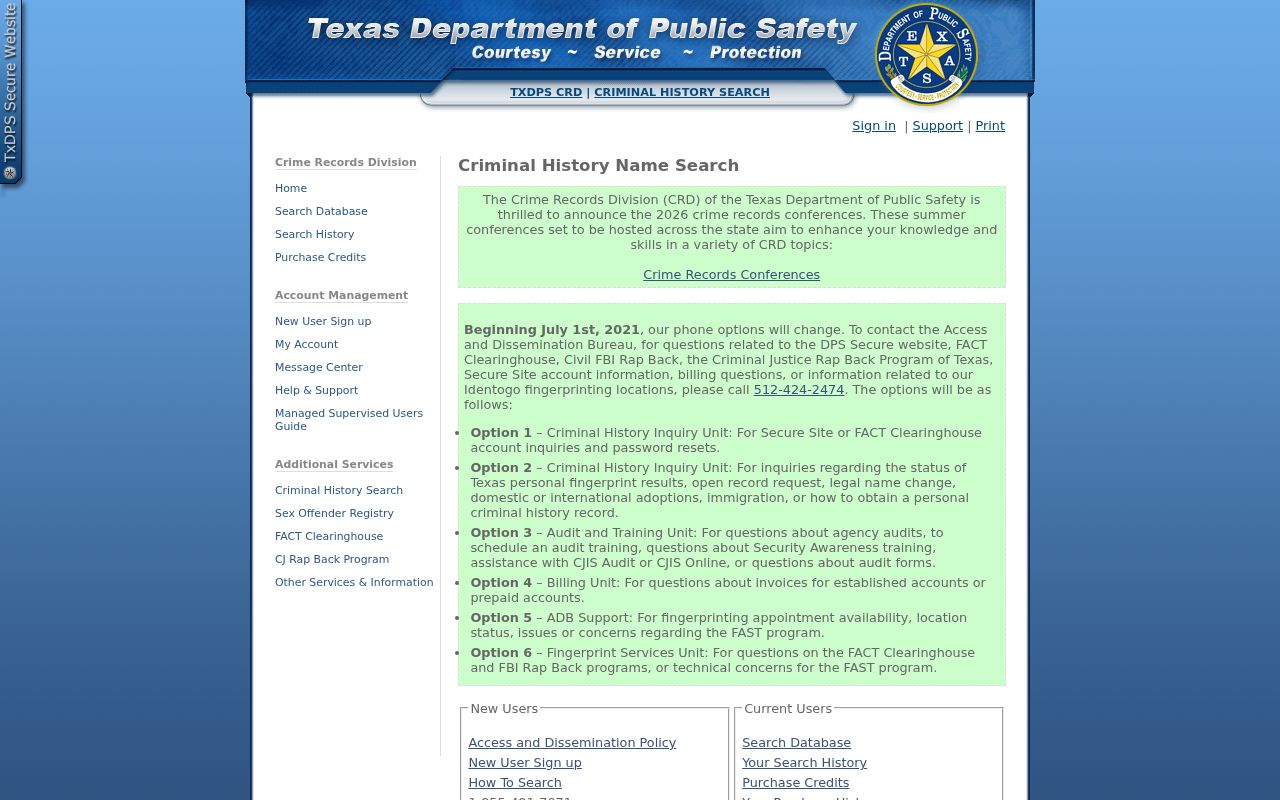
The search screen reinforces why legal name and birth date should be checked against the source case before relying on a possible match.
For personal self-review, DPS uses fingerprint comparison through Fingerprint Applicant Services of Texas, or FAST, delivered by IdentoGO. DPS lists a fifteen-dollar record fee plus a ten-dollar FAST fingerprint fee. Two hard cards cost twenty dollars. The agency estimates about ten business days after it receives the material, excluding mail time. No permanent enrollment site in Deaf Smith County was verified, so use the live vendor locator before naming a location.
Deaf Smith County Personal Record Channels
A fingerprint review is the strongest Texas route for checking one’s own record because the prints are matched to repository identifiers. Appointments are booked through IdentoGO online or at 1-888-467-2080. Bring the documents and service code DPS specifies. The live locator decides where appointments are available, and the nearest open site may sit outside Deaf Smith County.
The official FAST enrollment interface shown here is the proper place to schedule fingerprints. A third-party address should not be treated as a confirmed enrollment center.

The appointment route gives a self-review far more identity certainty than a public name search.
Search Deaf Smith County DPS Records Carefully
The DPS help material explains account setup, credit purchases, and the limits of name matching. Searchers should use a legal name and date of birth, then add sex or race only as narrowing identifiers. Exact spelling can help, but aliases and input errors can still hide the right record. The public product may also lack a disposition that was not reported or matched correctly.
The official DPS search instructions are captured below. They should be read before credits are spent because a no-match search still consumes a credit.

The instructions make the county clerk follow-up essential whenever the DPS result is blank, unclear, or inconsistent with a known case.
| Field | Use | Required |
|---|---|---|
| Last Name | Primary name match; exact spelling may be offered | Yes |
| First Name | Use the legal first name | Yes |
| Date of Birth | Separates many same-name results | Generally |
| Sex | Narrows a possible match | Optional |
| Race | Narrows a possible match | Optional |
| Submit | Runs the search and consumes a credit | Action |
Types of Criminal Records
Deaf Smith County records are grouped by the act that created them. Police and sheriff incident reports describe a reported event and the agency response. Arrest and booking records document custody, charges, bond, holds, and release. A prosecutor’s complaint, information, or indictment states the formal accusation. The clerk’s court file then tracks settings, motions, pleas, judgment, sentence, and appeal activity. None of these sources should be mistaken for another.
Other records sit beyond the courthouse. DPS links reported Texas criminal-history cycles. The Sheriff and jail retain local custody material. TDCJ maintains state correctional and parole information. Adult Probation, the local Community Supervision and Corrections Department, manages community supervision under court oversight. DPS also operates the Texas Public Sex Offender Registry, while local law enforcement maintains registration duties for residents.
- Incident and arrest records: agency accounts of the event, legal authority, place, time, and alleged offense.
- Booking records: jail intake, fingerprints, image, property, charges, bonds, holds, and custody events.
- Court case files: filed accusations, hearings, pleas, orders, judgment, sentence, and dismissal or appeal entries.
- Warrant records: court-issued process that may appear as a capias or warrant entry without full operational detail.
- Supervision and correctional records: probation, parole, county custody, or state custody kept by different agencies.
For an official federal layer, PACER covers federal cases, the FBI supplies subject-only Identity History Summaries, and the Bureau of Prisons covers federal custody. Federal products do not replace Deaf Smith County records.
Deaf Smith County Supervision Records Split
Community supervision and parole are separate record paths. Deaf Smith County Adult Probation, the local CSCD, supervises court-ordered felony and misdemeanor community supervision. The public judgment is the first source for whether that sentence was imposed. Daily supervision notes, treatment material, and risk information are not a general public lookup.
Parole follows release from a Texas prison sentence. The Board of Pardons and Paroles makes release and revocation decisions, while the TDCJ Parole Division supervises people on parole or mandatory supervision. A motion to revoke probation or adjudicate a deferred case may appear in the Deaf Smith County court docket. Parole warrants and revocation status route through TDCJ and the Board instead.
The official TDCJ Parole Division page shown below identifies the state supervision channel. It should not be used as a substitute for the local CSCD or the court judgment.
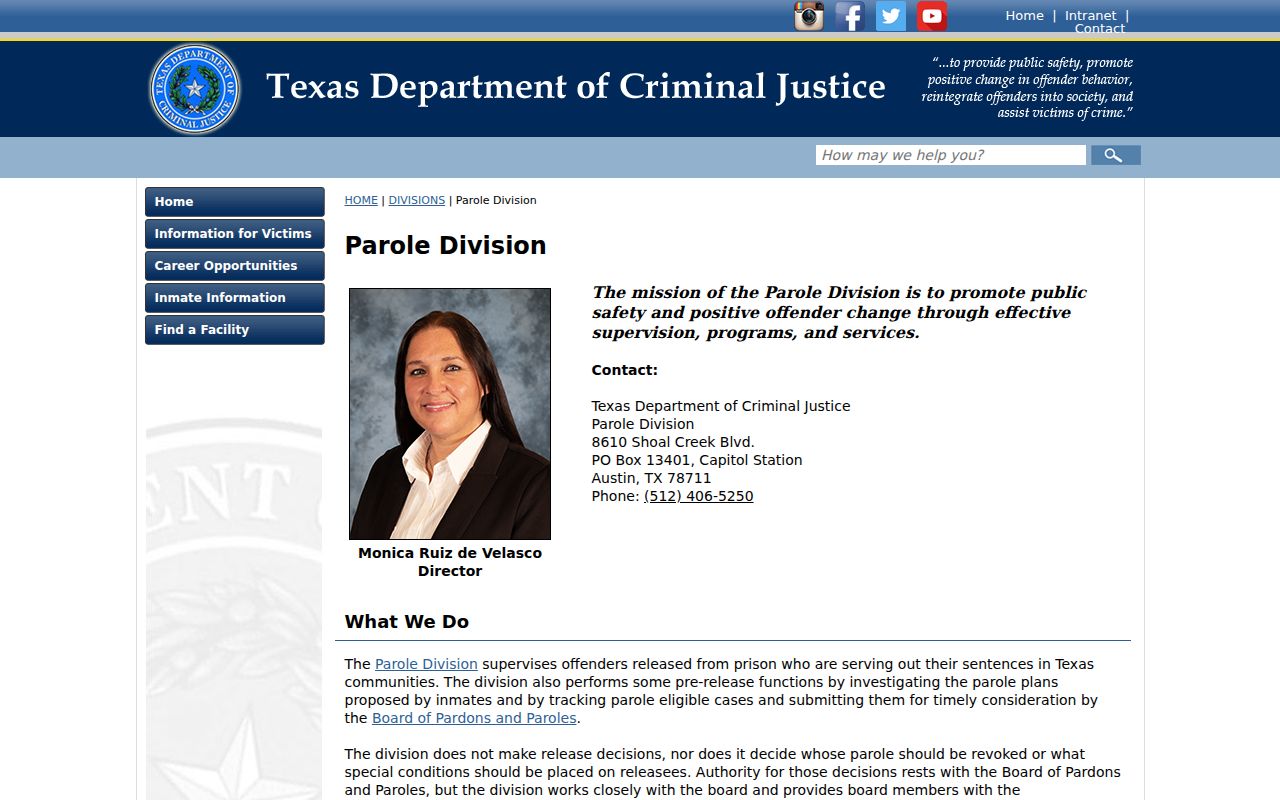
The split helps a searcher decide whether to call Adult Probation, inspect the court file, or use a TDCJ status line.
What a Deaf Smith County Criminal Record Shows
A Texas computerized criminal history is organized around identity and event cycles. It may connect aliases, date of birth, state or FBI identifiers, an arresting agency and arrest charge, prosecutor action, court cause number, disposition, sentence, and later custody or supervision reports. The clerk file is richer on hearings, motions, attorneys, judgment, and money. A booking entry is richer on intake time, bond, holds, and release. Readers should compare the record type before comparing the facts.
| Name & Identifiers | Legal name, aliases, date of birth, sex, race, and state or FBI identifiers where lawfully displayed. |
|---|---|
| Arrest / Booking Data | Agency, event number, arrest and intake dates, alleged charges, bond, holds, and release or transfer. |
| Charges & Statutes | Offense text, legal citation, degree or class, count, and offense date. |
| Disposition | Convicted, dismissed, acquitted, deferred adjudication, or another recorded outcome. |
| Sentence | Confinement, community supervision, fine, costs, restitution, and related court orders when public. |
| Custody / Supervision Status | County jail, TDCJ, community supervision, parole, release, or transfer information held by the proper agency. |
Protected identifiers, medical details, victim information, juvenile material, and sealed content may be absent or redacted. An empty field does not prove the underlying event never occurred.
Federal Records Beyond Deaf Smith County
Federal personal history, federal court files, and federal custody use three systems outside Deaf Smith County. A person seeking a self-record can order an FBI Identity History Summary for eighteen dollars, with possible added fingerprint or channeler costs. Federal criminal court cases for the county fall within the Northern District of Texas, Amarillo Division. Federal custody information belongs with the Bureau of Prisons.
The official FBI electronic-order portal shown below accepts subject-only Identity History Summary requests.

An FBI summary depends on data sent by contributing agencies, so an unclear local outcome still needs the clerk. Federal court documents instead come from the official PACER system, which generally charges ten cents per page subject to document caps and a quarterly thirty-dollar waiver threshold.
PACER covers federal dockets, not state cases in the 222nd District Court or Deaf Smith County Court.
Deaf Smith County Jail Record Fallback
No official public county inmate roster was found. Start with the Sheriff and jail at 3782 North Progressive Road, Hereford, or call 806-364-2311. Ask whether the person is now held, was booked and released, was transferred, or is housed elsewhere. If public, request the booking sheet or jail-log entry under the Texas Public Information Act. For a Hereford Police arrest, contact HPD separately for its incident report because the jail does not own that investigation.
After a state transfer, search TDCJ by name, TDCJ number, or SID number. TDCJ results can show the facility, offense information, sentence data, county of conviction, and projected release or parole dates when calculable. They do not show current county-jail bond data. IVSS can provide eligible custody and parole status plus confidential notification enrollment.
Note: No official Deaf Smith County sheriff app, jail blotter, or warrant app was verified in the county’s published materials.
Check Deaf Smith County Warrant Records
No official countywide active-warrant list was verified. A useful check is both court-specific and agency-specific. Call the Sheriff about county or district warrant information. Ask the District Clerk about felony cause activity and the County Clerk about misdemeanor causes. Hereford Municipal Court handles city and Class C warrants, while the Justice of the Peace retains matters in its own jurisdiction. A clerk docket may state that a capias was issued without exposing an operational law-enforcement record.
An arrest warrant rests on probable cause. A bench warrant or capias can follow a missed appearance or court order. A capias pro fine relates to enforcement of a fine judgment and remains subject to ability-to-pay safeguards. Search warrants, sealed indictments, juvenile warrants, and some unexecuted materials may not be public. Anyone trying to resolve a possible warrant should confirm the issuing court, cause number, charge, bond, and approved appearance process before acting. Do not assume a law-enforcement visit offers safe harbor unless the court has announced such a program.
Public Access Laws
The Texas Public Information Act gives the public a route to records held by government, but it does not cancel other confidentiality laws. Deaf Smith County may release basic offense information while withholding active-investigation material, protected criminal-history data, juvenile information, victim details, medical information, driver-license data, and jail-security content. When no prior ruling applies, an office seeking to withhold material generally follows the Attorney General decision process. The familiar ten-business-day point is a deadline tied to requesting that ruling, not a promise that all records arrive in ten days.
The Texas Attorney General open-government resources pictured below explain requests, costs, and public-body duties. They are useful when a Deaf Smith County custodian asks the requester to narrow a broad demand.

The state guidance also provides Open Government and cost hotlines, while the local office remains responsible for locating and reviewing its own files.
Key Statutes:
Government Code Chapter 552 gives access to public information while preserving stated exceptions.
Government Code Chapter 411 limits criminal-history disclosure and authorizes the DPS public conviction product.
Code of Criminal Procedure Chapter 66 governs reporting by arresting agencies, prosecutors, and clerks.
Code of Criminal Procedure Chapter 55 sets the rules for qualifying expunctions.
Deaf Smith County Record Gaps Matter
DPS reporting-completeness data shows why a statewide search must be checked against the clerk. Across 2020 through 2024, adult Deaf Smith County records listed 4,207 arrests and 3,592 reported prosecutor or court dispositions, an 85 percent five-year completeness measure. The annual figure moved from 93 percent in 2020 and 2021 to 90 percent in 2022, 83 percent in 2023, and 65 percent in 2024.
Those numbers are not crime rates. They measure whether expected case outcomes reached the criminal-history repository. A blank or old DPS entry may reflect a reporting lag, a matching issue, a restricted record, or a case still underway. It should not be read as a conviction, dismissal, or open case without the Deaf Smith County court file.
The local path is clear: confirm felonies with the District Clerk, Class A and B misdemeanors with the County Clerk, and fine-only Hereford matters with Municipal Court. This check is especially important when a DPS result does not show an outcome that the searcher knows occurred.
Sealed, Expunged & Restricted
Texas expunction under Code of Criminal Procedure Chapter 55 can remove qualifying records when exact outcome, timing, and procedural rules are met. Common routes may include an acquittal, pardon, no charge after the required period, qualifying dismissal or no-bill, and mistaken identity. Finishing a sentence does not ordinarily make a conviction eligible by itself. A person should obtain certified case documents and identify every agency that holds the arrest cycle before filing through the court the statute prescribes.
An order of nondisclosure under Government Code Chapter 411 restricts ordinary public disclosure for eligible criminal-history information but preserves access for listed government and authorized entities. It is not the same as destruction. Deferred adjudication often points toward nondisclosure rather than expunction, though eligibility depends on the offense, prior history, waiting period, and statute in force.
Deaf Smith County did not publish a local petition form or filing fee in the reviewed material. Ask the District or County Clerk which court handles the case, then request the judgment, discharge, dismissal, no-bill, or acquittal needed to evaluate the remedy. After an order is implemented, review the DPS personal record and local docket for stale data.
Request Deaf Smith County Sheriff Records
The county does not publish a separately branded Sheriff’s Records Division, dedicated records email, online request portal, or downloadable local form. The reliable starting point is the Sheriff’s main office at 3782 North Progressive Road, Hereford, TX 79045, telephone 806-364-2311 and fax 806-363-6656. Ask which custodian holds the exact item, such as an offense report, booking sheet, jail log, warrant information, CAD record, 911 audio, or body-camera recording.
Send a written, focused request under the Texas Public Information Act. Include the agency, record type, incident or booking number if known, date and time range, location when relevant, preferred delivery format, and contact details. For body-camera material, identify the date, approximate time, place, and one or more people depicted. Ask for an electronic copy and an itemized estimate before charges accrue. No local Sheriff fee schedule, payment method, or promised turnaround was found.
Deaf Smith County Sheriff and Jail
3782 N. Progressive Road
Hereford, TX 79045
806-364-2311
District Clerk and 222nd District Court
235 E. Third Street, Room 304
Hereford, TX 79045
806-364-3901
Hereford Police Department
212 Lee Avenue
Hereford, TX 79045
806-363-7120
Note: An HPD arrest report stays with police even when the Sheriff’s jail later creates the booking record.
Criminal Records by City in Deaf Smith County
Hereford is the county seat and Deaf Smith County’s only incorporated city. Its police department writes city incident and arrest reports, while Hereford Municipal Court keeps ordinance and fine-only state-law cases. A city arrest may then create a separate booking at the county jail and a later misdemeanor or felony file with the proper county clerk. The Deaf Smith County arrest history route explains that handoff in more depth.
Hereford Criminal History
2025 estimate: 14,976 · HPD reports, county jail bookings, and Municipal Court records follow distinct channels.
The city estimate comes from the July 1, 2025 Census Bureau vintage. Dawn and other unincorporated communities do not have a separate municipal police and court layer, so they are not padded into the city list.