
Running a Sex Offender Check in Deaf Smith County
The Texas Public Sex Offender Registry is the main public channel for Deaf Smith County. Texas DPS manages the statewide index, while local law enforcement registers covered residents and sends updates into that system. A person who lives within Hereford registers under the police chief's authority. A resident outside a municipality registers with the Deaf Smith County Sheriff. That division of work matters when a profile seems stale or suspected noncompliance needs to be reported.
Start with the county or city filter when the goal is place-based awareness. Use a name only when enough facts are known to separate people with similar names. The result is a registration record, not a full criminal history. It does not collect every arrest, case, or conviction. For broader records, the county's criminal history overview explains how local clerks and Texas DPS answer different questions.
Note: A registry result identifies a statutory registration record, not a finding about a person's current conduct or risk.
Searching the Texas Public Sex Offender Registry
The state interface offers several routes into Deaf Smith County registry records. A county search is useful for the rural and city area together. A Hereford search narrows the view to the incorporated city, while an address, ZIP, or map search supports a location-based review. Search fields may work as alternate paths, so not every box must be filled at once. Too many guessed details can hide a valid match.
- Open the official Texas DPS registry and read its conditions of use before searching.
- Choose a name path or a place path. For local results, select Deaf Smith County or enter Hereford, an address, or a ZIP code.
- Review the result list and compare the photograph, aliases, age, and physical traits. Do not rely on a shared name.
- Open the public profile and read its location, offense, registration authority, compliance, and status fields together.
| Field Label | Type | Required | Notes |
|---|---|---|---|
| Name | Tab and text | Varies | First-name and last-name search path |
| Address | Tab and text | Varies | Street, city, ZIP, and proximity path |
| County | Dropdown | No | Select Deaf Smith County |
| City | Text or dropdown | No | Use Hereford for the city layer |
| ZIP Code | Text | No | Enter five digits |
| Map Search | Map or tab | No | Search the visible geographic area |
The official Texas registry search screen shows these name, place, and map routes in one public tool.
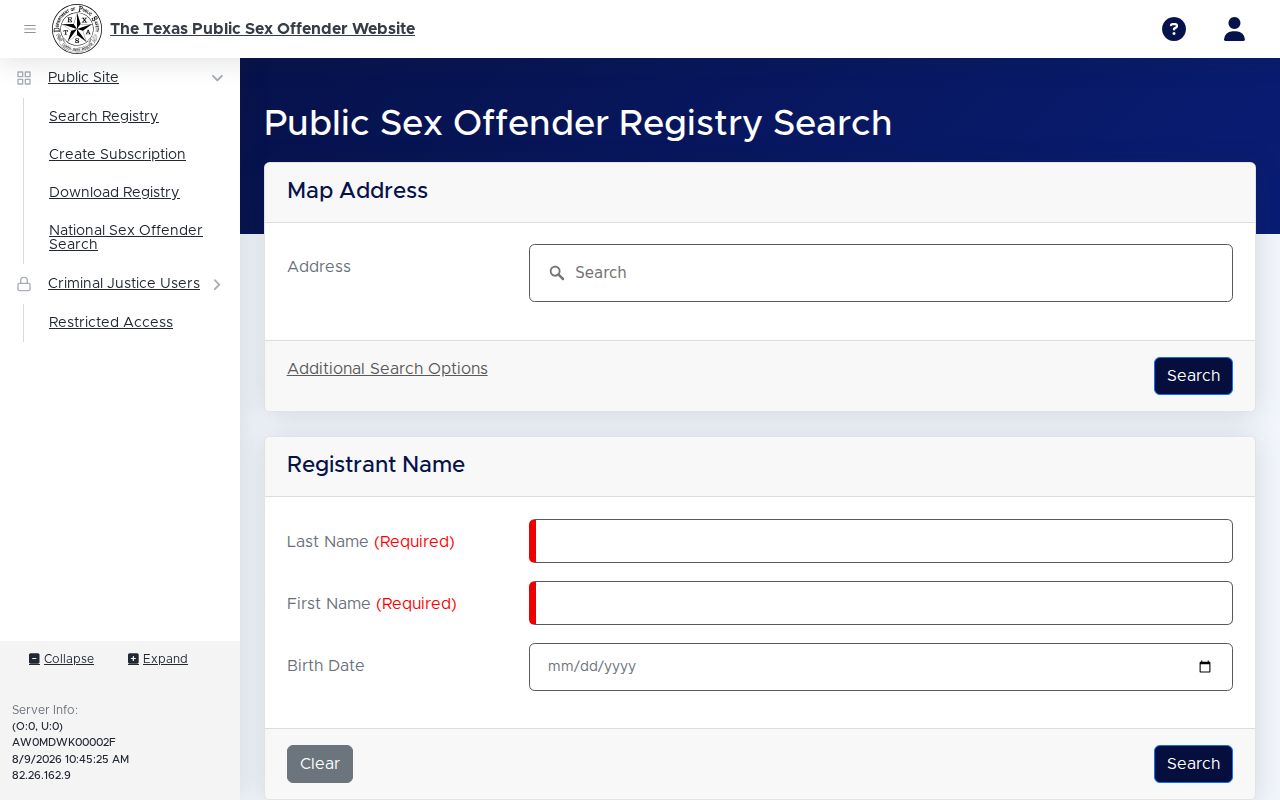
Its separate paths let a reader widen or narrow a Deaf Smith County search without turning a partial name into a false match.
Deaf Smith Registry Maps for Hereford
An address or map search answers a different question than a name search. It shows public registry locations near a place in Hereford or elsewhere in Deaf Smith County. Search the current address, set the area shown by the interface, and then open each result for the full profile. A map point should be checked against the written location data because scale, boundaries, and map placement can affect what appears on screen.
Hereford also adopted a city residence rule effective April 21, 2025. It restricts certain registrants whose qualifying offense involved a victim under 17 from setting up a permanent or temporary residence within 2,000 feet of listed child-focused places. The rule defines permanent residence as 14 or more straight days. Temporary residence includes 14 days in a calendar year or four days in a month. Its exceptions and written City Secretary appeal route are separate from the statewide duty to register. A registry map should not be used to decide by sight whether the ordinance applies.
What a Registry Profile Shows
A public Deaf Smith County profile combines identity clues, location facts, registration status, and the qualifying offense record. Texas DPS may publish a color photograph, aliases, physical traits, birth or age information, primary and secondary locations, the registering authority, compliance status, offense description and statute, conviction or adjudication date, victim age category, punishment, supervision status, institution information, and qualifying vehicle details. Each field serves a distinct role in confirming the right record.
| Name & Aliases | Primary name and known public aliases used to distinguish a possible match. |
|---|---|
| Photo & Physical Description | Color photo plus public sex, race, height, weight, eye color, hair color, and age details. |
| Location Information | Public primary and secondary location information, subject to the profile and statute. |
| Offense & Statute | Reportable offense, law, conviction or adjudication date, victim age category, and punishment. |
| Registration Authority | Hereford Police or the Deaf Smith County Sheriff, based on where the resident lives. |
| Registration Status | Public registration or compliance information and related supervision or institution facts when applicable. |
| Vehicle Information | Qualifying make, model, color, and license data when Chapter 62 makes it public. |
Note: Compare multiple profile fields because a name by itself is too weak to confirm that a record belongs to one person.
Deaf Smith Registry Match Mistakes
A common mistake is treating one shared name as a confirmed Deaf Smith County registry match. Compare the photo, aliases, age, physical traits, location, offense, and registering authority before reaching that point. Another mistake is treating a profile as a complete criminal history. The registry is limited to reportable offenses and current statutory publication rules. It does not list every case linked to the person.
Location searches also need care. A Hereford address result, a county filter, and a map view can show different slices of the same public data. Widen the map or change the place field before concluding that no Deaf Smith County record appears. Then verify the selected profile on the official DPS system.
Deaf Smith Registry Privacy Boundaries
The public registry is broad, but it is not the full file held by DPS or a local registration authority. Texas collects fingerprints, Social Security and driver-license numbers, telephone numbers, online identifiers, employer details, and other administrative data. Chapter 62 and the DPS guidance keep specified identifiers, employer identifying or contact facts, confidential DPS-added fields, and victim-identifying information out of public display. Juvenile registration may also be ordered nonpublic.
A blank field or missing public profile is not proof that no registration file exists. A court order, juvenile rule, search mismatch, recent move, or reporting step may affect what the public can see. When a Deaf Smith County result appears incomplete, use the registering authority shown in the record rather than guessing. That office can receive a report of suspected noncompliance, though it may not release confidential fields in response.
Registration Requirements and Levels in Texas
Texas does not present its public registry as a simple Tier I, Tier II, and Tier III chart. Registration time turns on the reportable offense, the governing statute, the disposition, age, release or discharge dates, and any court order. That is why a profile and the current text of Code of Criminal Procedure Chapter 62 matter more than a borrowed federal tier label. Local officials send registration facts to DPS, and covered people must report and verify changes under the schedule that applies to them.
| Texas Category | Duration | Public Effect |
|---|---|---|
| Adult offense listed in Article 62.101 for lifetime | Lifetime | Public registry subject to statutory field limits |
| Other adult reportable conviction or adjudication | Generally ten years after release or discharge | Exact offense and statute control the end date |
| Juvenile registrant | Generally ten years after the later release, discharge, or dismissal | Court orders and statutory exceptions may make registration nonpublic |
| High-risk or civilly committed person | Controlled by the applicable lifetime and commitment rules | Public registry plus DPS community postcard notice rules |
A registrant generally reports by the later of seven days after arrival or the first date allowed by the authority's policy. The exact duty and verification cycle must be read from Chapter 62 and the person's registration status rather than inferred from this broad duration chart.
The Texas DPS registration program overview explains how state and local duties work together.
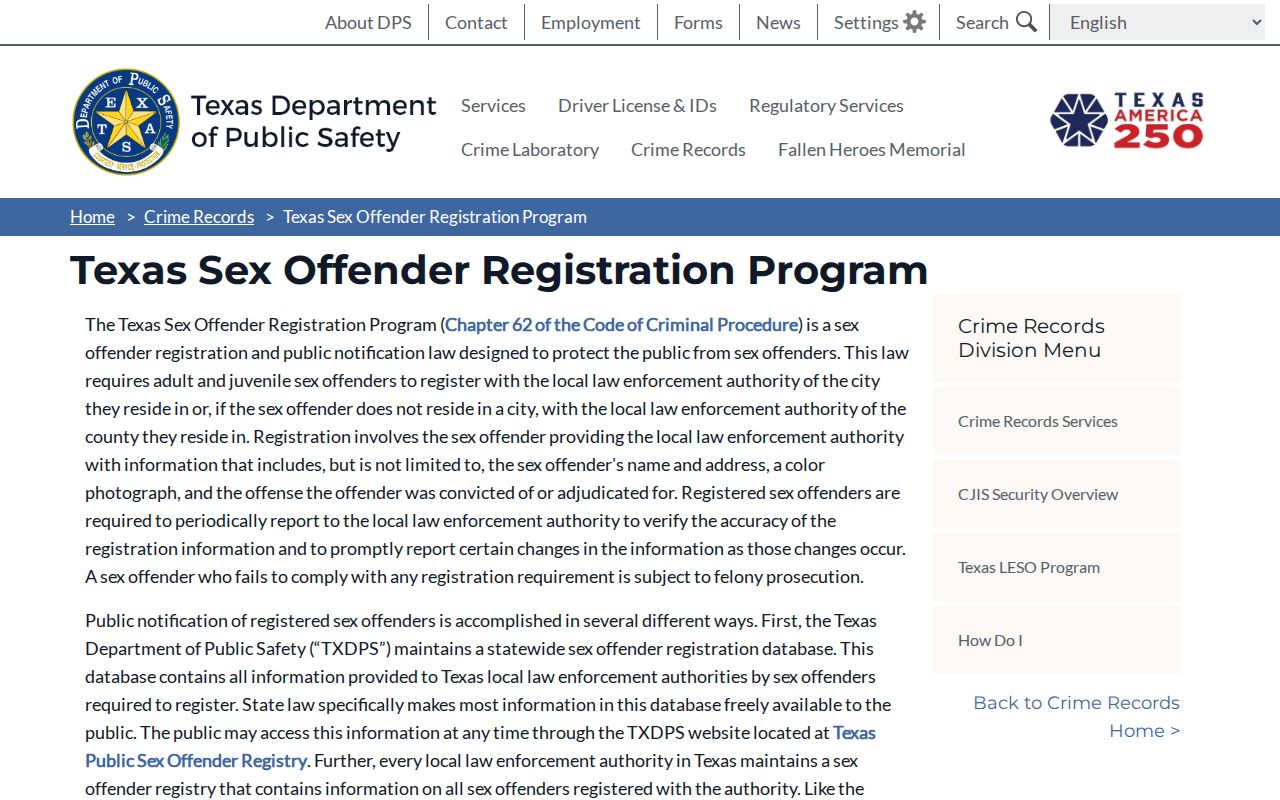
That program page is the best state source when a Deaf Smith County profile raises a question about duration, notice, or the responsible authority.
Cross-State Registry Search from Deaf Smith
The National Sex Offender Public Website, run by the U.S. Department of Justice, adds a cross-state layer. It is useful when a name or place question crosses the Texas border, or when a person recently moved and the correct state is uncertain. NSOPW searches participating jurisdiction data and routes the reader back to the public source that supplies the detail. It does not replace the Texas registry for a focused Deaf Smith County review.
Search both systems with the same care. Jurisdictions do not all publish the same fields, and timing can vary. Confirm a Texas result on the DPS profile and use the named registration authority for local concerns. For a person outside Texas, follow the jurisdiction link returned by NSOPW rather than applying Texas rules to another state's record.
The official national search makes the participating-jurisdiction boundary clear before a query begins.
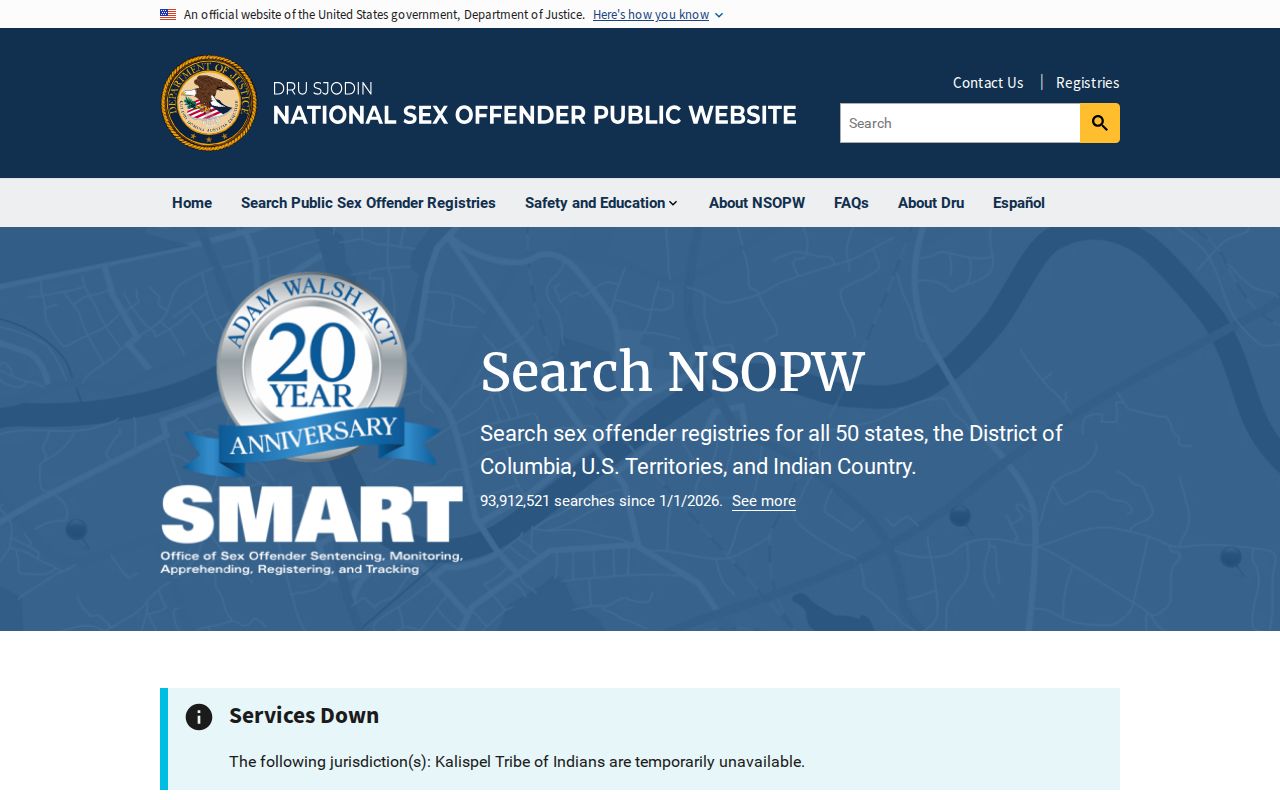
Used after the Texas search, it can show whether the inquiry belongs with Deaf Smith County or another public registry authority.
Reporting a Deaf Smith Registry Concern
Read the profile first and note the registration authority, public status, and location facts. A concern about a Hereford resident belongs with Hereford Police at 806-363-7120. A concern about a person living outside the city belongs with the Deaf Smith County Sheriff at 806-364-2311. Give the agency the public facts that prompted the concern. Do not confront the person or try to test compliance yourself.
For a question about state registry policy or a possible DPS record issue, call DPS Sex Offender Registration at 512-424-2800. An immediate threat or active emergency goes to 911. The local office may investigate compliance and update DPS through the official reporting process, but protected investigative facts may not become public.
Lawful Use and Community Notification
Registry data exists for public awareness and safety planning. It should be read in context, checked against the public profile, and limited to the facts Texas law permits DPS to release. High-risk and civilly committed cases may also trigger DPS postcard notification rules. Local authorities notify schools where Chapter 62 requires it. Those notice tools do not authorize threats, public shaming, or private punishment.
Use registry data lawfully: Texas DPS warns that harassment, threats, intimidation, or other misuse of registry information may lead to civil or criminal consequences under Code of Criminal Procedure Chapter 62.
A Deaf Smith County profile also should not be treated as a current risk score. The record reports a qualifying legal event and registration duties. It does not tell a reader what a person will do now. When accuracy matters, confirm the public entry with the official registry and the authority named on the profile.