
Criminal Cases in the Deaf Smith County Courts
Deaf Smith County criminal court cases split by offense grade. The 222nd Judicial District Court tries felonies. Its District Clerk keeps the charging papers, docket activity, orders, judgments, and sentences. The constitutional Deaf Smith County Court hears Class A and Class B misdemeanors through the County Clerk. Hereford Municipal Court and the Justice of the Peace keep fine-only cases within their own powers. A city citation or municipal capias may never appear in a district search.
The distinction affects more than the place to call. A felony may move from complaint and magistration to a grand-jury indictment, while a misdemeanor commonly proceeds on a complaint or information. The State of Texas is the prosecuting party in the court file. The arresting agency's first charge is only the start. The filed charge, court events, and final judgment show what the court actually did.
The county's official District Court page shows the local felony court in its government setting.
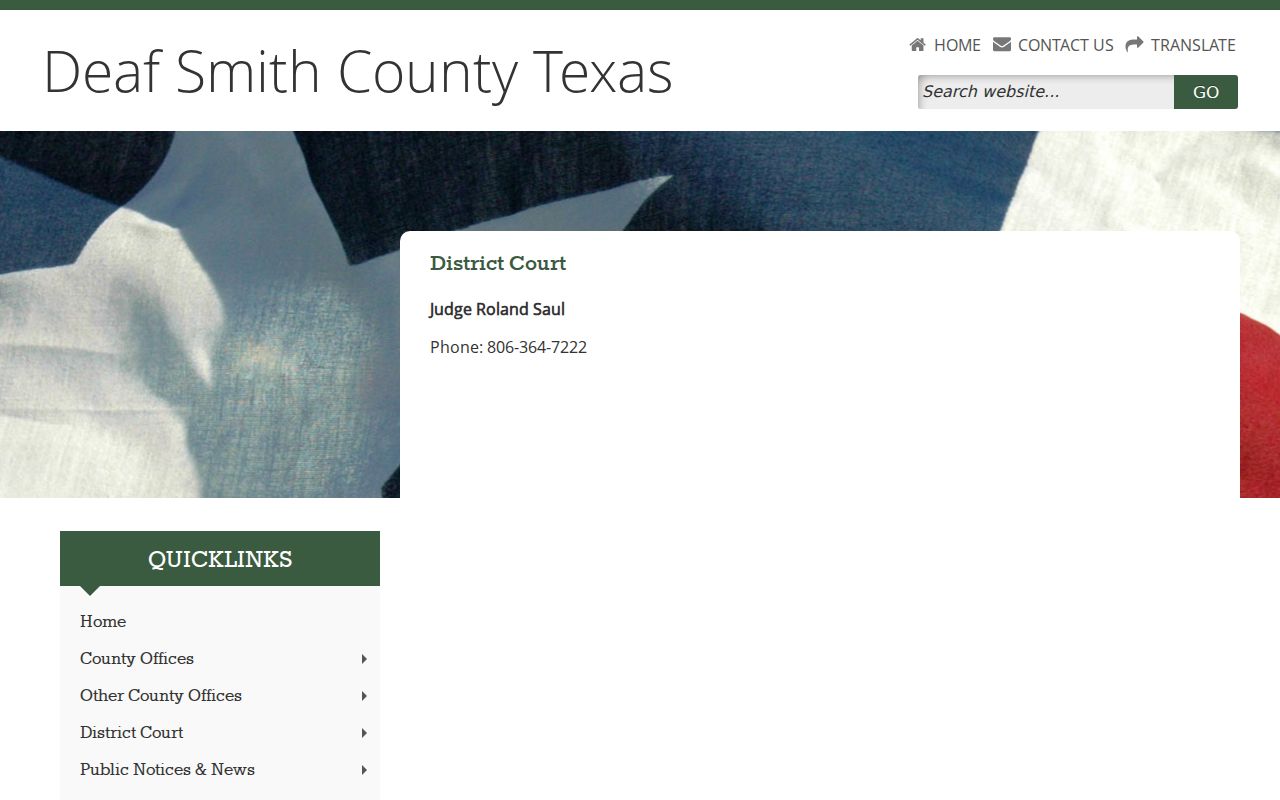
That court identity is the first fact to confirm before asking for a Deaf Smith County felony case file.
Deaf Smith Felony Case Desk
The Deaf Smith District Clerk is the working records counter for a felony case. It is in Room 304 of the Deaf Smith County Courthouse, 235 East Third Street, Hereford, Texas 79045. The office telephone is 806-364-3901, and its fax is 806-363-7007. A 2025 Office of Court Administration verification confirms that the office files criminal cases and uses iDocket as its case-management system.
The District Clerk page is the source for the local contact channel.
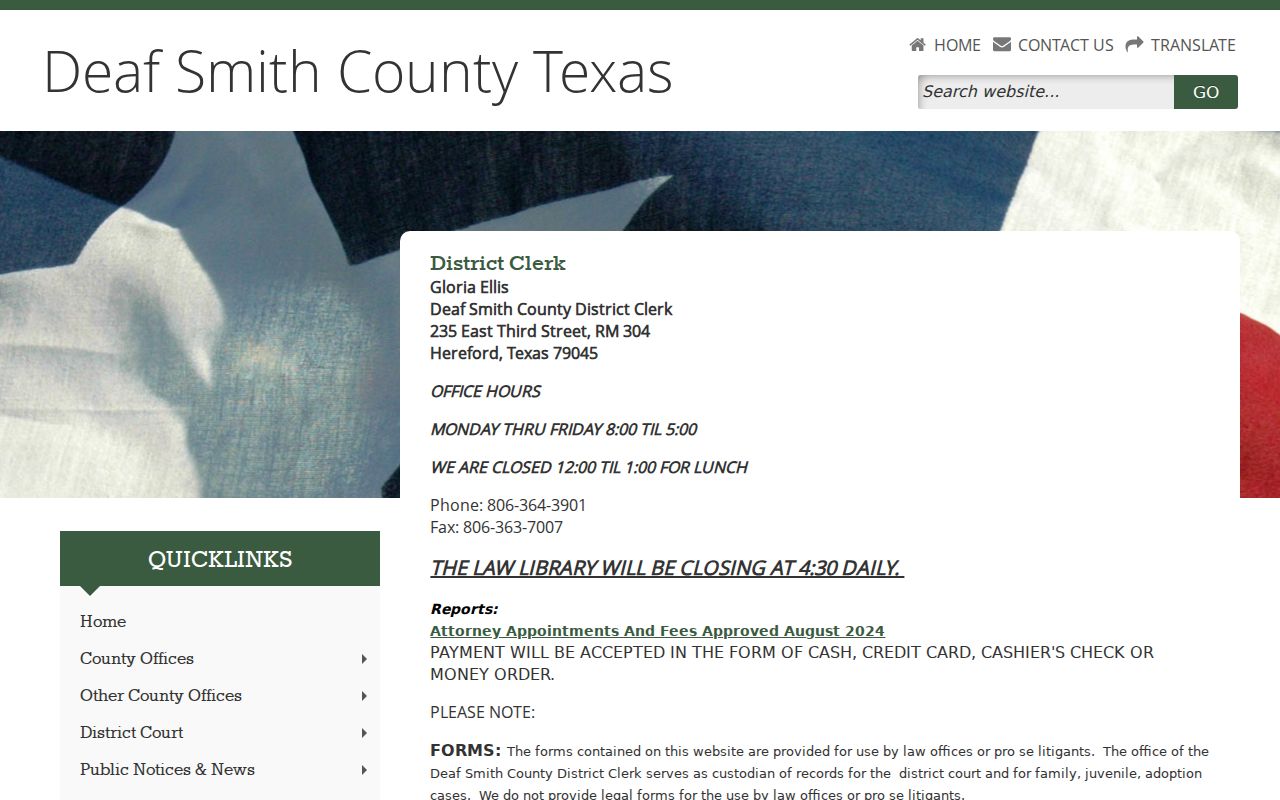
Call that desk before a trip to ask whether public remote access is enabled, which years are indexed, and whether the needed document image is online or only at the counter.
Deaf Smith District Clerk
235 E. Third St., Room 304
Hereford, TX 79045
806-364-3901
Felony criminal files, docket sheets, judgments, sentences, and certified copies when available.
How to Search Case Records
Start with a cause number whenever possible. It is a stronger key than a name and helps the clerk distinguish the right Deaf Smith County criminal case. If only a name is known, give the clerk enough detail to narrow the search without treating a same-name result as proof. Ask whether iDocket has a public view for the period at issue. No stable county link or coverage date was verified, so phone and counter access remain essential.
- Identify whether the matter is a felony, county misdemeanor, municipal citation, or Justice Court case.
- Contact the matching clerk and search by cause number first, or by the defendant name when needed.
- Narrow the result by court, filing date, case type, charge, and any other identifier the clerk offers.
- Open or request the register of actions, then compare the filed charge with the listed disposition.
- Ask for the charging instrument, judgment, sentence, dismissal, or discharge order and request certification if the use requires it.
| Search field | Type | Use | Deaf Smith limit |
|---|---|---|---|
| Cause number | Text | Best direct key | Use the full clerk format |
| Defendant name | Text | Find possible cases | Confirm more than one identifier |
| Court | Filter | Separate court levels | Municipal files are not district files |
| Filing date | Date | Narrow common names | Coverage is not published |
| Case type | Filter | Limit to criminal matters | Ask which labels iDocket uses |
Deaf Smith Court Search Limits
iDocket is the local case system, not a promise that each Deaf Smith County criminal document can be opened on the web. The county did not expose a stable official public case-search URL, a start date, or an image-access rule. Some entries may be indexed without a viewable filing. Older cases may be on paper or in an archive. When a result is missing, ask the clerk to search the office index rather than assuming the case never existed.
The statewide re:SearchTX portal offers Cases, Filings, Text, and Hearings tabs with keyword and result filters.
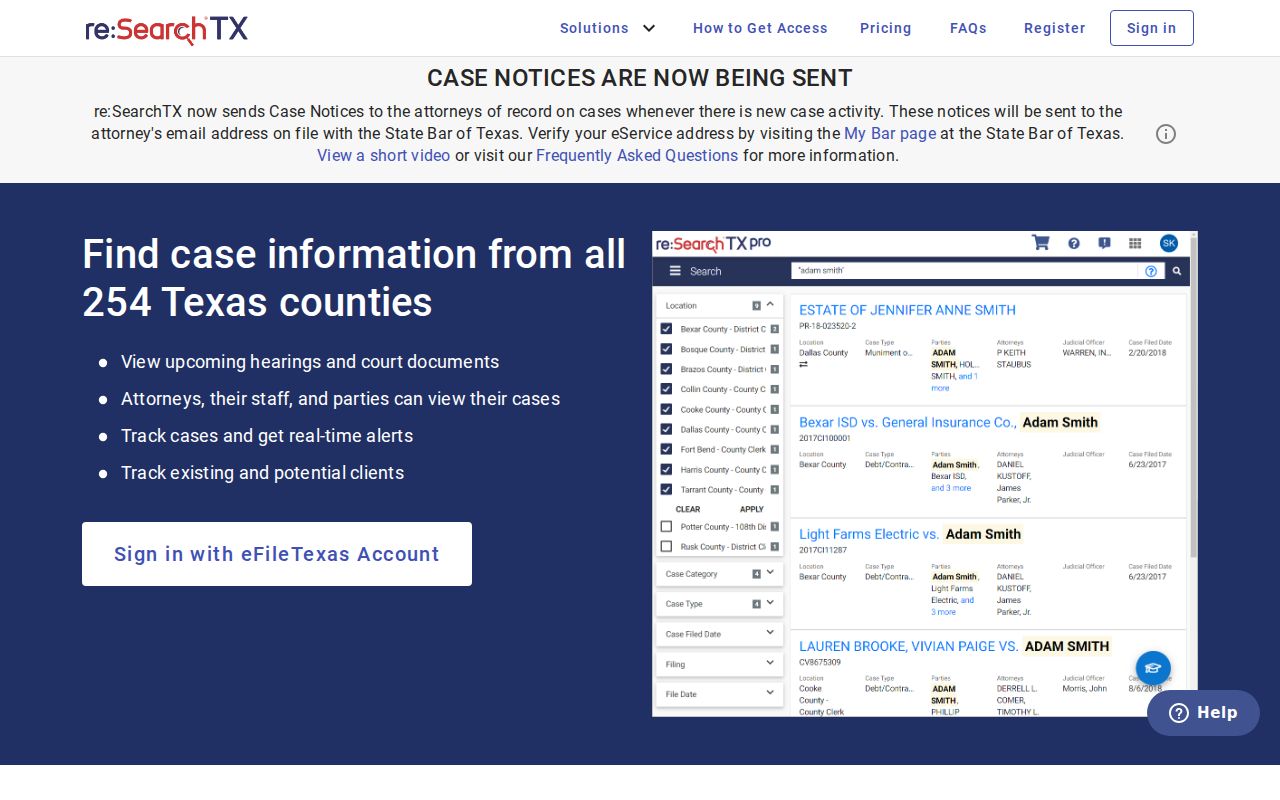
Texas Judicial Council reporting says its public statewide collection excludes criminal case records. Use it as a general court tool, not as a complete Deaf Smith criminal index.
What the Case File Shows
A Deaf Smith County court file is document-centered. It can show the formal accusation, settings, motions, rulings, plea, trial result, and sentence. Requesting only the docket sheet can miss the exact terms in a signed judgment or dismissal. Ask for the documents that answer the question, and verify that each one carries the correct cause number and court.
| Case Number & Court | Identifies the cause and whether it belongs to District, County, Municipal, or Justice Court. |
|---|---|
| Charging Document | Shows the complaint, information, or indictment and the charge actually filed. |
| Docket Entries | Lists filings, settings, bond actions, motions, pleas, capias events, and court rulings in date order. |
| Hearing Dates | May show the event date, hearing type, courtroom, and judge when those details are public. |
| Disposition & Judgment | Records whether the charge was convicted, dismissed, acquitted, deferred, or otherwise resolved. |
| Sentence & Conditions | May state confinement, community supervision, fines, costs, restitution, and other public terms. |
Protected identifiers, victim or minor information, sealed material, and some document images will not be public. The clerk can explain the access result but cannot turn a restricted filing into a public one.
Deaf Smith Case Filing Routes
The offense grade points to the right records office. The Deaf Smith County Clerk holds County Court files for Class A and Class B misdemeanors. The District Clerk holds felony files in the 222nd District Court. Fine-only Class C matters can remain with Hereford Municipal Court or a Justice of the Peace. A person who calls only one office may receive a correct “no case” answer for that office while the record sits in another.
The official County Clerk page shows the separate misdemeanor custodian.
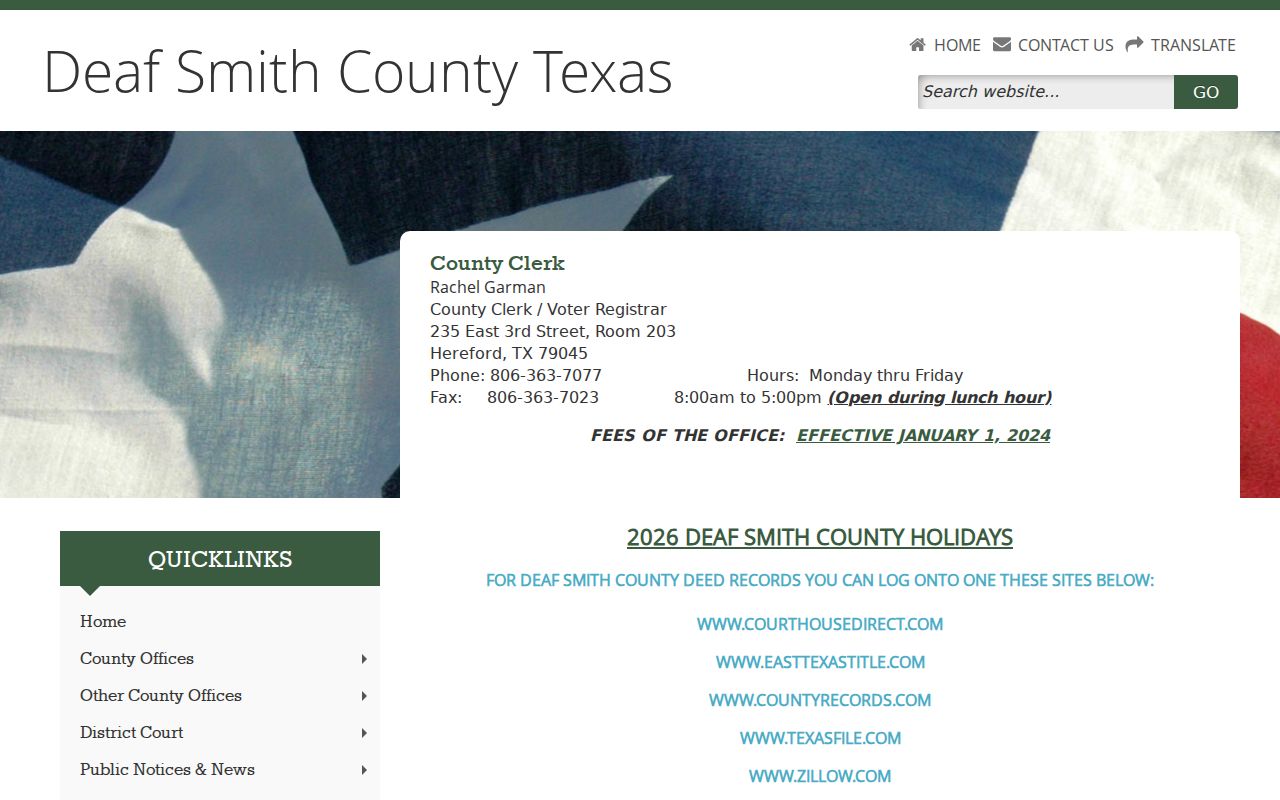
This split is why the offense class and court name should be written down before requesting a docket or judgment.
No local copy-fee schedule or public counter hours were found on the accessible pages. Ask about cost, payment, delivery, certification, and archive retrieval before submitting a broad request.
Deaf Smith Criminal Disposition Terms
Disposition words tell how a charge ended. They should not be read as synonyms. A Deaf Smith County case may also show more than one count, with a different result for each. Match the term to the count, date, and signed order. If the docket label is terse, request the judgment or dismissal paper instead of guessing.
- Convicted
- A court entered a judgment of guilt after a plea or trial.
- Dismissed
- The prosecution ended on that charge without a conviction, subject to the terms of the filed order.
- Acquitted
- The judge or jury made a not-guilty determination.
- Deferred adjudication
- The court deferred a guilt judgment while community supervision is completed under the order.
- No-billed
- A grand jury did not indict the submitted felony accusation.
Note: A dismissal or acquittal does not by itself erase the related arrest and booking records from every agency system.
Stages of a Criminal Case
A Deaf Smith County criminal case does not become final at arrest. After the prosecutor chooses a charge, a complaint may support early proceedings. A felony normally moves through grand-jury review and indictment unless a lawful waiver applies. The court then handles arraignment, pretrial motions, and a plea or trial. Judgment, sentence, and any appeal follow the result. Article 15.17 generally calls for magistration without needless delay and no later than 48 hours after arrest, but that first appearance is not the trial.
Case flow: Charges Filed › Arraignment › Pretrial › Plea or Trial › Disposition › Sentencing
The full Deaf Smith County arrest history route explains the booking record that may exist before the clerk receives a criminal filing.
Older Deaf Smith Criminal Files
The 1910 Deaf Smith County Courthouse still houses the District Clerk and the district criminal record. Its age creates a practical issue: old cases may not share the same online coverage as new filings. Call Room 304 before traveling. Give the cause number, court, party name, and approximate filing year, then ask whether the file is active, archived, paper-only, or available as a scanned image.
Also ask about access to the building and office. Public pages did not state parking, entry screening, device rules, or the local process for language and disability assistance. Confirm those needs in advance. If a certified copy is needed, say so at the start because a plain docket printout and a certified judgment serve different purposes.
Access & Restrictions
Texas court records are presumptively open under judicial access policy, but that rule has limits. Sealed files, juvenile information, protected victim data, private identifiers, and records affected by an expunction or nondisclosure order may be withheld or redacted. An online view may expose less than the clerk's public paper file, yet the counter cannot release material made confidential by law.
The Texas Public Information Act governs many agency records, while court-file access also follows judicial rules. Government Code Chapter 411 limits criminal-history dissemination, and Code of Criminal Procedure Chapter 66 governs reporting into the state history system. These layers explain why a clerk file and a DPS result can differ.
When a public file seems incomplete, ask the Deaf Smith clerk whether the cause is sealed, archived, misindexed, held by another court, or awaiting a later docket update. The clerk's signed final order remains the best source for the court outcome.